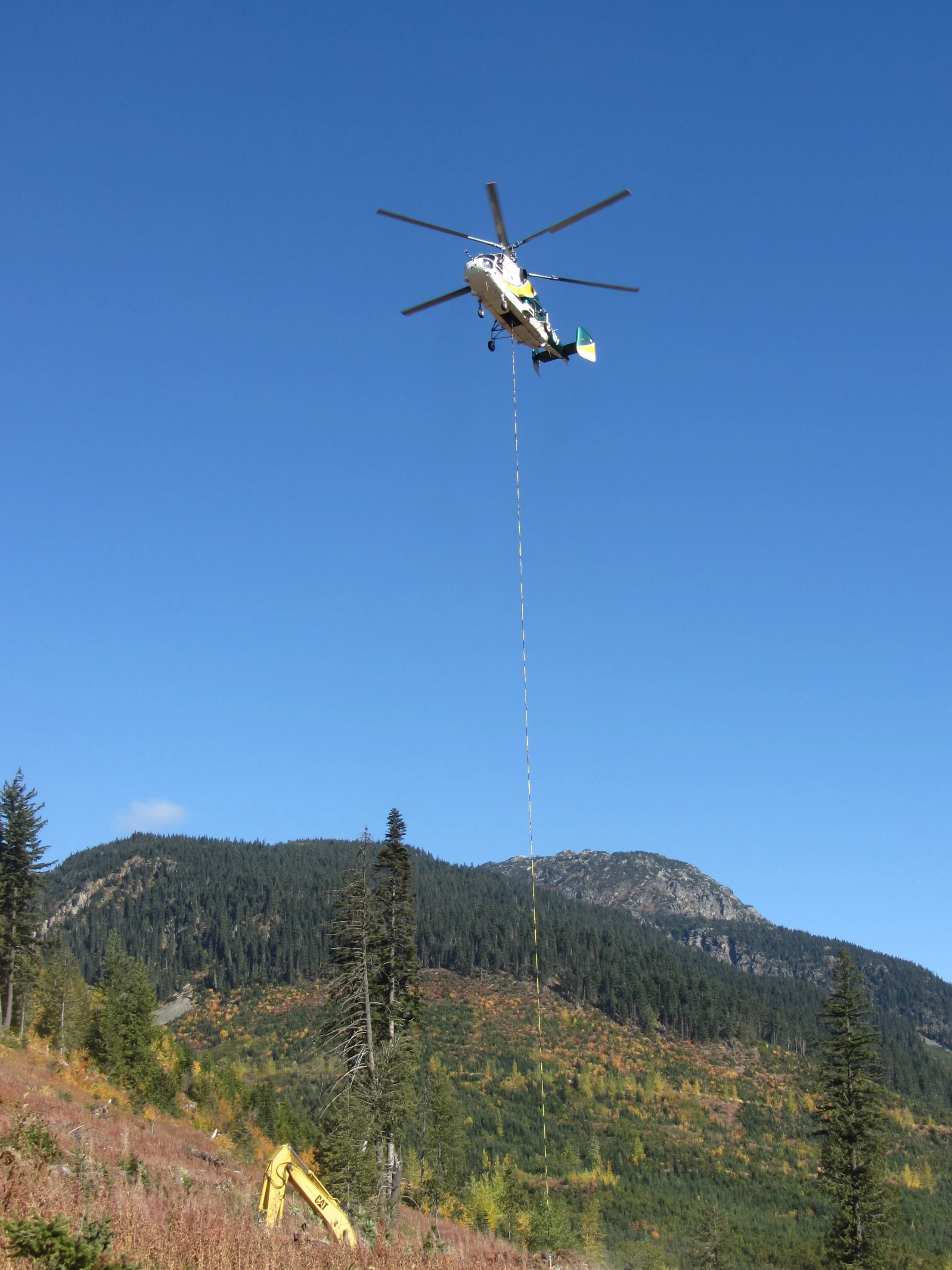
TCS 101 - Long line training
What is Long Line training?
Long line training teaches crew members how to safely carry out a general and precision slinging / external load operation.
This course can be customized to meet client-specific operations and incorporates real-world scenarios to enhance safety, communication, and operational effectiveness.
Who should take this course?
People involved with managing and operating external load projects.
Industry examples: aerial construction, utility power line, mining and exploration, drilling, forestry, environmental field work, oil and gas, wildland firefighting crew, search & rescue, emergency medical services, and more.
What’s included?
Basic helicopter safety
Work procedures
Risk assessment and emergency Procedures
Communication: radio, visual, and hand signals
Review of Crew Resource Management (CRM) concepts
Equipment and load management: classification of loads, rigging techniques, and general & precision loads.
Field Operations: sending and receiving loads, working around energized transmission circuits, conducting precision operations, and executing aerial construction.
Practical helicopter safety during long line operations.
How long is this training?
1 day: Classroom training in the morning, followed by a practical helicopter sessions in the afternoon
What is the benefit of long line training?
Meets Transport Canada, WorkSafeBC, and BC Hydro requirements for CARs 702 operations.
Accepted as equivalent for BC Hydro HELI-101
Reduces risk for employees and crew members
Increases operational effectiveness
Increases safety and communications for field operations
Decreases liability for helicopter company and clients